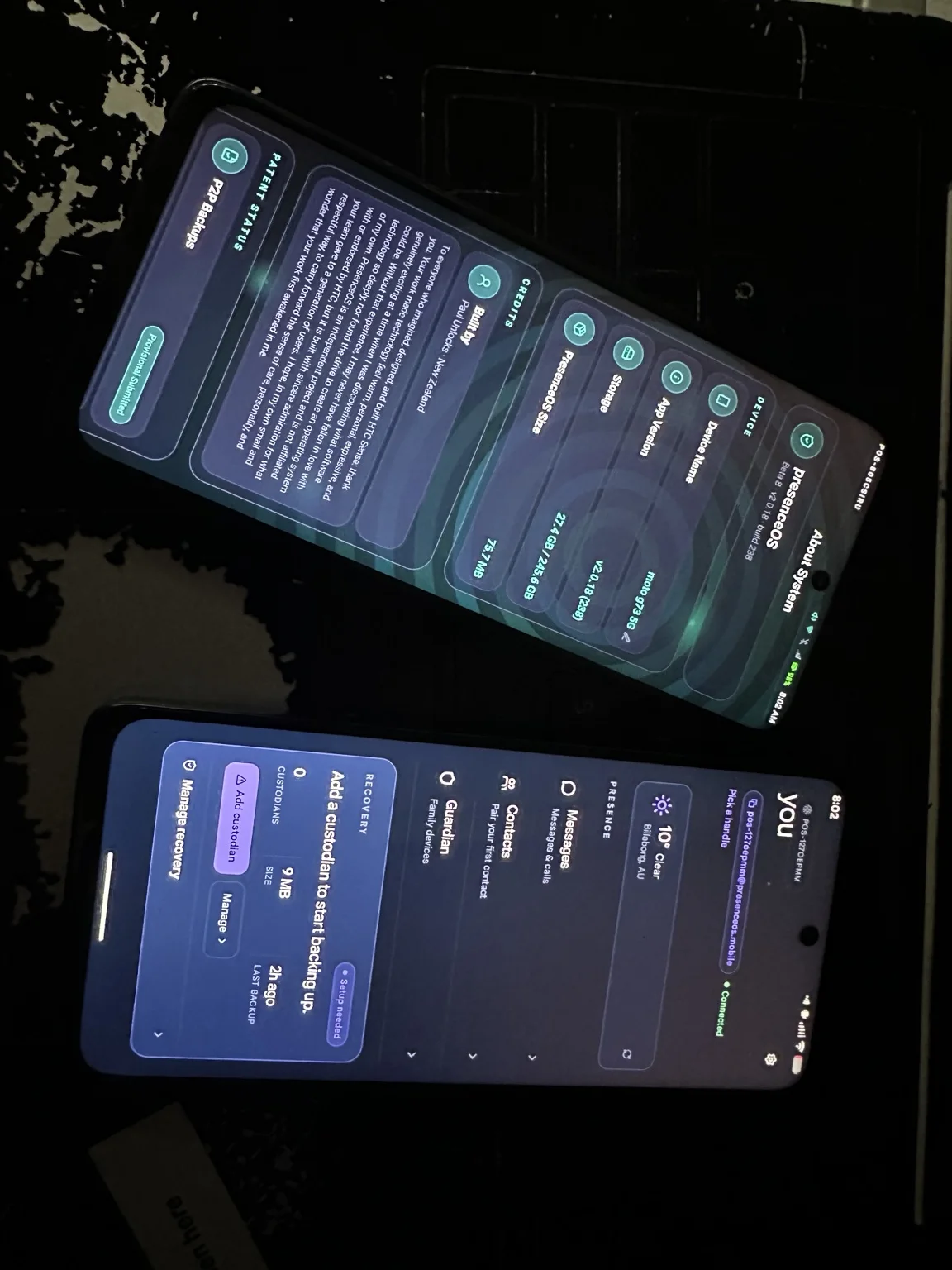
What Exists Today
PresenceOS ships today as a fork of Android: a self-signed generic system image (GSI) in which SystemUI, Settings and the notification shade are replaced by PresenceOS's own, running with system-level access on the child's device, plus Guardian Relay on the parent's existing phone. The PresenceOS layer is React Native with native Kotlin/Java modules wherever Android needs them. Pairing, messaging, voice and video calling all work now, end-to-end encrypted, and contact pairing is NFC tap-to-pair — both devices physically together.
The communications stack is WebRTC over a self-hosted relay. There are no user accounts anywhere in it: no passwords, no email or phone signup. Identity is a keypair generated on the device, and the relay authenticates devices by challenging that key. There's no SMS onboarding step and no carrier-controlled identity verification in the flow.
Infrastructure
The relay runs on my own hardware in New Zealand. So does everything else: the DNS serving these domains, the web server serving this page, mail, the handler behind the contact forms, and the git server the source lives on. Zero cloud providers, zero Cloudflare, zero Google services in the stack. Push notifications work without Google's FCM — devices hold a long-poll wake channel to the relay instead. The backend is deliberately simple, because one person has to hold all of it in their head.
The git hosting is a recent change: on 9 July 2026 I moved all PresenceOS source off GitHub onto my own git server, on my own hardware. For a privacy product, hosting the code on someone else's platform was — in hindsight — a mistake, open source or not. The blog covers the move and the supply-chain events behind it in depth.
Updates
The update pipeline is: I build the APK, publish it to my own server, and the app updates itself from there. The relay enforces a minimum-version floor, so a build with a known security problem can't keep connecting — old clients are forced forward rather than left exposed.
Source Code
Stated plainly: PresenceOS is closed source, at least during development. That's a deliberate choice, not an oversight — it protects me, the codebase, and my workstation while this is very much a beta being built by one person. How the licence looks later is a decision I'll make together with the people who invest in me and in this pilot.
PresenceOS still leans on decades of open source, GNU and copyleft work, and I intend to contribute back where I can. And closed source doesn't mean closed to scrutiny: if you're a security researcher and want to review the code, ask — that's a conversation I want to have.
Funding
The project has received $10,000 of government funding. Honestly framed: that's a little funding, miles away from my targets — but it proves this is fundable. Every step of development is documented; every thought and action is stored and available for scrutiny by serious parties.
Battery Life
On my test hardware, PresenceOS gets roughly 45% longer battery life than the stock firmware on the same devices. That's my own informal measurement, not a lab result. Most of it is simply the absence of background chatter — no Google services phoning home, no FCM connection, no ad SDKs. Cutting it further is an ongoing goal.
Future Hardware
- No USB data port
- No charging port
- No SD card slot
- No audio jack
- Wireless charging
- Internal service connector only
None of this is for novelty. Every port you remove is an attack surface you no longer have to defend.
Beyond Android
PresenceOS ships on Android today, and I won't pretend otherwise. But the move off Android is no longer research on paper: I have a booting Linux userspace on a Motorola Edge 50 Fusion that is completely void of Android and Google — the phone's hardware, the vendor's drivers and hardware-interface layer, and my own systemd userspace running the PresenceOS UI on top. Think postmarketOS, but it's PresenceOS — only PresenceOS.
It's early — a first iteration — but it boots on my bench today. The vendor's proprietary driver code is still required at that layer for now; one day it won't be. While the firmware matures, the Android fork — PresenceOS on our own system image — is the shipping vehicle.
Communications Independence
Today: encrypted communications over data connections.
Later: mesh networking, LoRa and direct device-to-device links. I want to be clear that these are research topics on my bench, not current features.
Long-Term Vision
The end state I'm working toward is PresenceOS hardware where users own their identities and their communications, and cellular networks become optional transit rather than mandatory gatekeepers.
Get In Touch
PresenceOS stays a one-person project — that's the point, since everything running through one accountable person is the product promise. But I do want testers, security review, and blunt technical feedback. If you work in Android, embedded systems, networking, cryptography, hardware or UX and want to poke at this, email paul@presenceos.email — self-hosted mail, on-brand — or call +64 22 629 2483. Both land with me directly, and any bug you find gets fixed by the person who wrote it.